
The Marshall Islands will be the first nation to introduce a universal basic income. To ease the task of distribution, it will provide cryptocurrency as one payment option.
Every resident of the sovereign island nation in the Pacific known as the Marshall Islands will now receive a quarterly payment of $200. This universal income is said to be the first of its kind in the world and is aimed at easing the cost-of-living pressures for its citizens. These payments will be available in three different methods. This includes fiat currency and cryptocurrency-based options.
Stablecoins and Universal Basic Income
Cryptocurrency has had a tumultuous year, rising to record highs and then sinking to huge lows. In October, Bitcoin reached a level of over $126,000. Binance noted that BTC touched these levels amid record U.S. spot ETF inflows exceeding $5.9 billion over two weeks, lifting the total crypto market cap to fresh peaks near $4.3 trillion. Yet by December, cryptocurrency prices had fallen due to macroeconomic and global concerns. Bitcoin is now trading at around $87,370 as of December 18th.
To avoid this volatility, the Marshall Islands plan to include what is known as a ‘stablecoin’ option in its UBI scheme. This is a cryptocurrency that is pegged to the value of a real-world asset, such as the USD. This negates some of the inherent price fluctuations within cryptocurrency. This method was also chosen as it solved a very physical issue of distributing income to people spread across hundreds of smaller islands.
The first payments were given at the end of November. Recipients had the choice to accept it into a bank account, have it paid by cheque, or use a government-backed digital wallet. However, only around 12 recipients have chosen the latter method so far, with 60% having it added to a bank account and the rest choosing cheques.
The Marshall Islands Basic Income Scheme
David Paul, the Marshall Islands’ minister for finance, said, “We, the government, want to make sure no one is left behind. $200 per person per quarter, which is about $800 a year, does not compel you to quit your job … but it’s actually like a morale booster for people.”
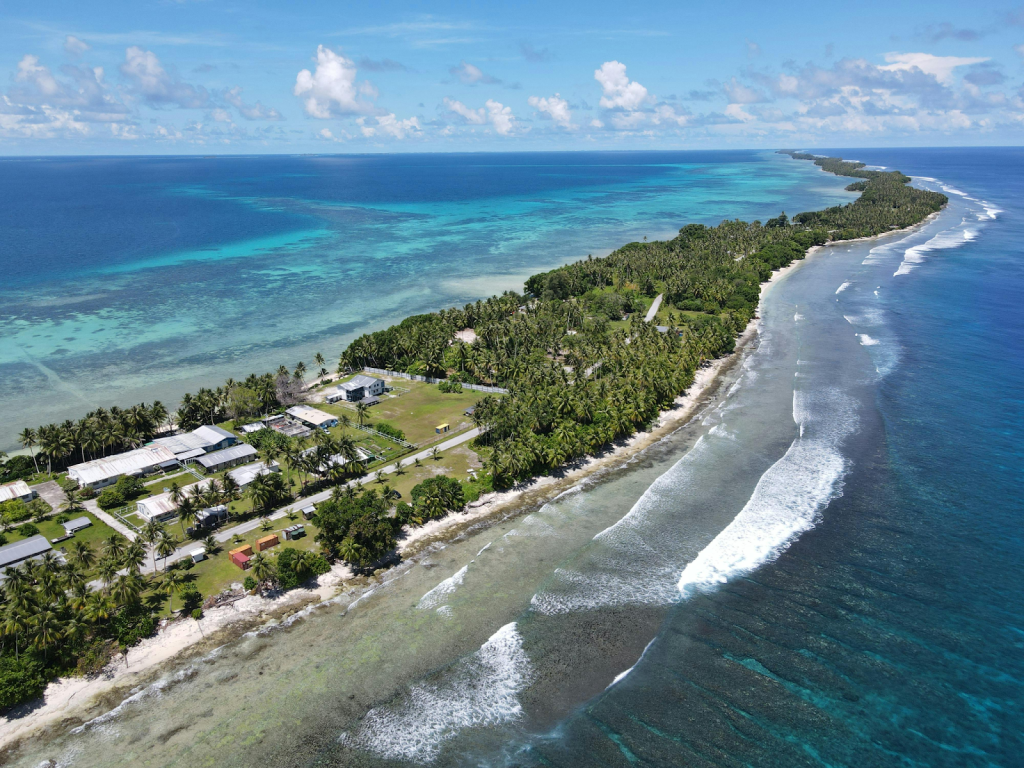
The Marshall Islands sit between Australia and Hawaii in the Pacific. It has a very small population, numbering 42,000. Its citizens are spread across hundreds of small islands, presenting their own unique set of problems. Distributing anything becomes troublesome, including aid. This has led to increased costs of living, with many choosing to emigrate for a cheaper and easier life.
Funds for this scheme are being taken from a US-Marshall Islands compact. Valued at $1.3 billion, it is in part being paid as reparations for nuclear testing that has taken place there in the past. Another $500 million has been pledged by the United States through 2027. Around half of the country’s budget comes from US foreign aid.
Blockchain Adoption in the Marshal Islands
The concept of issuing this in cryptocurrency has shown the potential of cryptocurrency, especially in financial situations where traditional banks and institutions may struggle. It has solved many of the delivery headaches. Payments can be made quickly, across multiple accounts. This can also reduce fees, which could total 10% if done through financial institutions.
There is also a safety in cryptocurrency. An immutable ledger records transactions and reduces the risks of fraud. Allowing access in places where there are no brick-and-mortar banks also increases inclusion, allowing all to access the money they deserve.
Yet it has also highlighted some big weaknesses, in that hardly anyone has chosen this option. With so few people choosing to adopt this, limited internet access and smartphone adoption rates may prove a defining factor.
It is also not the first time the nation has turned to cryptocurrency to solve its issues. In March 2018, they decided to issue their own cryptocurrency known as the SOV. The idea was formulated by Neema, an Israeli fintech company. At the time, the country had only the First Hawaiian Bank operating on its shores, and the government was naturally worried it would leave. Cryptocurrency seemed the answer to its prayers.
The idea for the SOV was eventually vetoed by the IMF, lest they be cut off from the international banking system altogether. The President Hilda Heine was given a vote of no confidence, leaving the idea dead in the water.
Denying the possibilities of stablecoin use in these areas is foolish. Yet more adoption needs to be sought out first, and this will not come without changes to infrastructure in the islands. For now, the concept will remain an optional extra. As the citizens of the islands bask in this universal basic income, this economic boost could spark this investment, and the Marshall Islands may yet get the blockchain benefits long promised.
