
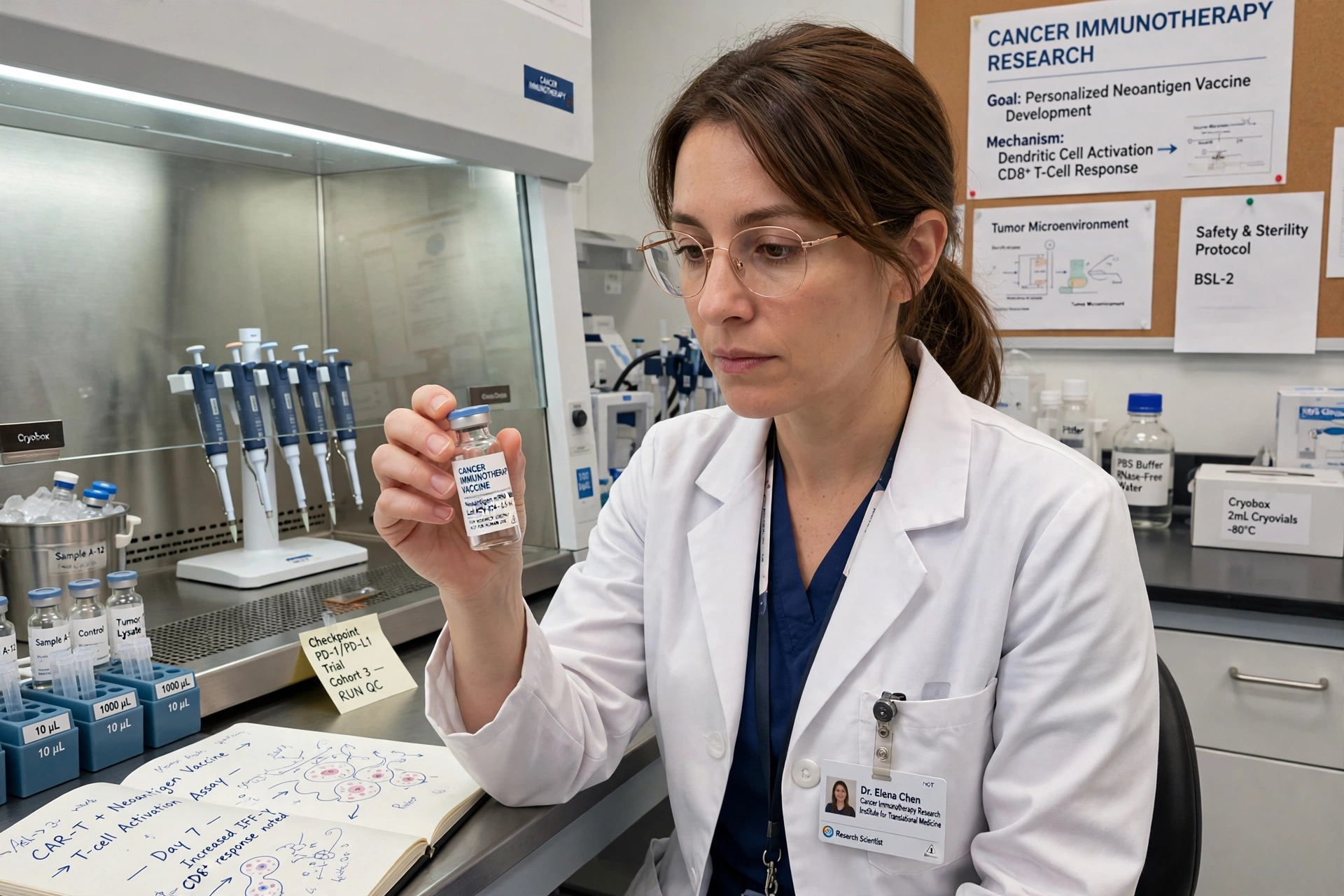
The idea behind personalised cancer vaccines is elegantly biological: learn the unique molecular fingerprints of a patient’s tumour, then train her immune system to hunt cells carrying them. That idea has now been tested, at the earliest clinical stage, in platinum-sensitive ovarian cancer. A phase 1 trial published in Nature Medicine combined the NeoVax vaccine, built from individual tumour neoantigens, with nivolumab and found the treatment feasible with an acceptable safety profile. The result matters for the field of immunotherapy — while saying nothing yet about whether patients live longer as a result.
An early test, carefully framed
The study in Nature Medicine belongs to the earliest stage of clinical testing. Researchers gave a personalised vaccine called NeoVax, designed from the neoantigens in each patient’s tumour, together with the immunotherapy nivolumab to people whose ovarian cancer remained platinum-sensitive. Their published conclusion is deliberately modest: production and delivery proved feasible, and the safety profile was acceptable. In drug development, those two findings are the gateway to everything else, because a therapy that cannot be manufactured reliably or tolerated by patients goes no further.
The science of neoantigens
Neoantigens exist because cancer cells accumulate mutations. Some mutated proteins are displayed on the cell surface, where in principle the immune system can learn to attack them while sparing healthy tissue. A NeoVax-style vaccine attempts to train that response using a selection of targets unique to the individual’s cancer. Combining it with nivolumab, which blocks the PD-1 checkpoint that tumours exploit to dampen immune attack, aims to teach and unleash the immune system at the same time — an appealing idea that early data can support but cannot yet validate. Readers can explore further background from Nature, which provides additional context on the research and the institutions involved.
Working with the immune system, not around it
Unlike treatments that attack cancer directly, a neoantigen vaccine tries to enlist the body’s own defences and aim them precisely. Neoantigens arise from tumour mutations, so in principle they mark cancer cells out from healthy ones, and nivolumab is added to stop tumours from switching the responding immune cells off. The trial’s contribution is to show that this tailored, two-part strategy can actually be assembled patient by patient. For a disease where recurrence is common and options narrow, a workable new mechanism is worth pursuing rigorously.
A difficult disease context
Patients and clinicians have good reason to want progress. Ovarian cancer often recurs, treatment choices narrow over time, and checkpoint drugs alone have not produced the dramatic benefits seen in melanoma or some lung cancers. Platinum-sensitive disease, where cancer responds again to platinum chemotherapy after a break, defines a group whose outlook is better than average yet still uncertain. Testing new combinations in this setting is scientifically sensible, provided expectations stay anchored to what a small, early trial can show. For more on a related subject, see our earlier coverage: our report on glucose monitors and type 2 diabetes.
What would convince sceptics
The next evidence must be comparative. Researchers need larger groups, random allocation where ethical, and clear endpoints such as how long disease stays controlled and how patients feel during treatment. Manufacturing speed matters too: a vaccine that arrives too late helps no one. Until those data exist, the honest summary is that an intricate, personalised approach passed its first practical test in ovarian cancer. That is worth reporting accurately, and worth following, without turning a phase 1 milestone into a promise.
Proportion matters in reporting medical research. This was a first-step safety study, not a breakthrough announcement, and its authors frame it that way. The encouraging news is real; it is simply the start of a longer evidentiary road.
What happens after a phase 1 result
After a study like this, the research path typically widens before it pays off. A phase 2 trial enrols more patients and begins, cautiously, to look for signs of benefit — how often tumours shrink or stay controlled, and in whom — while continuing to track safety. Only if those signals justify it does a large phase 3 comparison follow, the kind of study that can change standard practice. Each stage takes years and many programmes stop along the way, which is not failure but filtering: the system is designed so that treatments reaching routine care have survived progressively harder questions.
