
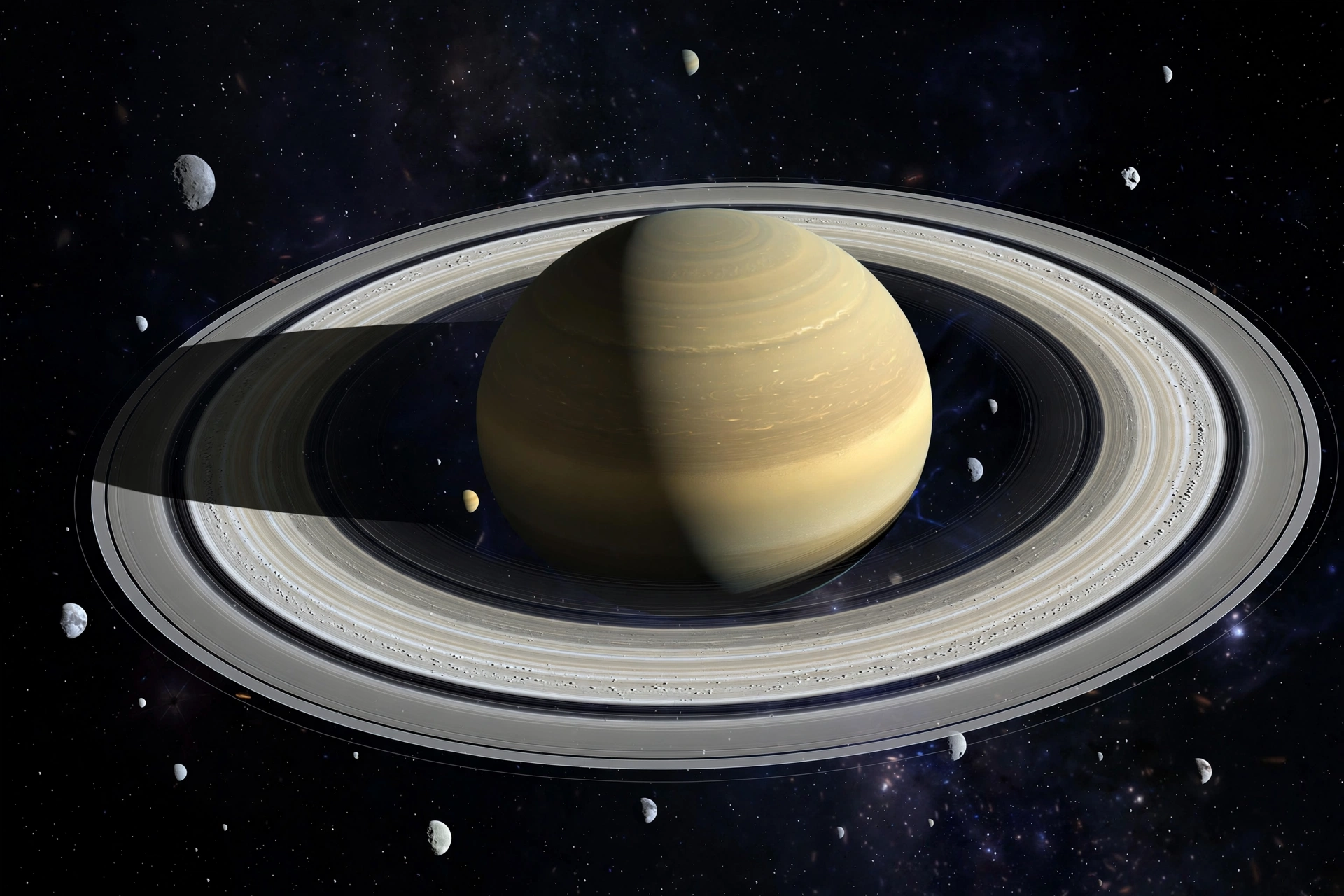
There is something quietly wonderful about a planet collecting moons the way Saturn apparently does. With 128 further moons now confirmed, Saturn’s recognised total has reached 274, comfortably the highest figure in the solar system. The new arrivals are not grand worlds but small, dark fragments, drifting in distant orbits that astronomers have only recently become able to trace. Their confirmation, following observations with the Canada-France-Hawaii Telescope and recognition by the International Astronomical Union, turns Saturn into an even richer natural laboratory for anyone interested in how planetary systems organise — and recycle — their material.
From candidates to confirmed moons
A moon does not join the official list the moment a telescope spots something moving. Astronomers must observe the object repeatedly, sometimes over years, until its orbit around Saturn can be predicted reliably. The 128 additions cleared that demanding bar, lifting the planet’s recognised total to 274. Researchers involved in the Canada-France-Hawaii Telescope survey, including scientists at the University of British Columbia, sifted through stacked images in which faint specks shifted slightly against distant stars, then checked those movements until the International Astronomical Union could accept them.
A very different kind of moon
Anyone picturing 128 new versions of our own Moon should adjust their expectations. These are irregular satellites: small, dark and distant, following looping paths that can be tilted sharply against Saturn’s equator and even run opposite to the planet’s rotation. Some are probably captured asteroids or Kuiper Belt objects. Others look like debris from ancient impacts. Their modest size, often just a few kilometres, explains why they escaped notice until sensitive cameras and patient image-stacking made them visible. Readers can explore further background from the University of British Columbia, which provides additional context on the research and the institutions involved.
Small moons, natural histories
Looked at ecologically, irregular moons resemble the overlooked species of a habitat: individually inconspicuous, collectively revealing. Their clustered orbits hint at parent bodies that broke apart, scattering fragments which have travelled together ever since, slowly altered by sunlight and gravity. Each cluster is a record of an ancient impact, preserved in motion rather than in rock strata. Cataloguing these faint companions is therefore less about collecting records and more about reading a natural archive, one in which Saturn has preserved evidence of collisions that Earth, with its restless geology, erased long ago.
Reading a history of collisions
The scientific value lies in the patterns. When several irregular moons share similar orbits, researchers suspect they were once a single body that fragmented. Mapping those families helps date collisions and understand how Saturn’s surroundings evolved after the planets formed. It also sharpens comparisons with Jupiter, Uranus and Neptune, whose own irregular populations tell related but distinct stories. In that sense the new count is not merely a record for trivia quizzes; it is fresh evidence about violence, capture and slow gravitational sorting in deep space. For more on a related subject, see our earlier coverage: our earlier look at microplastics research.
The search continues
Nobody in the field believes 274 is a permanent ceiling. Detection depends on telescope sensitivity, viewing geometry and the sheer labour of confirming orbits, so each generation of instruments tends to revise the number upwards. Planned observations will test whether the new moons stay grouped as expected and whether still fainter companions appear. Saturn, already unmatched for its rings, now holds the solar system’s moon record by a wide margin, and the margin itself has become a useful measure of how quickly observational astronomy is improving.
Saturn’s total will probably rise again as instruments improve, but the deeper point stands: a system that looks serene through a telescope is, on closer inspection, a crowded, dynamic environment where creation and destruction have been under way for billions of years.
Why totals like this keep changing
Readers sometimes ask why astronomers did not simply count Saturn’s moons once, definitively, long ago. The answer is that counting is limited by light: a three-kilometre moon reflects so little sunlight that it can hide in a planet’s glare for decades, visible only when images are combined cleverly and checked repeatedly. Each improvement in cameras, software and computing power therefore reopens the census. Far from suggesting earlier astronomers were careless, the rising total shows how thoroughly they worked with far weaker tools — and how much of the solar system still sits just below the threshold of visibility.
